Quick Navigation
UK registration plates can provide a useful indication of a vehicle’s age, helping drivers identify when a car was first registered. However, a vehicle’s registration year does not always identify the exact model generation, facelift, or interior layout. This can be particularly important when ordering tailored car mats, as manufacturers often make changes during a vehicle’s production life. Understanding how UK registration plates work can help narrow down the correct vehicle, while avoiding some of the common mistakes associated with model changeover years.
UK Number Plate Year Guide
Use the table below to quickly identify when a vehicle was first registered using its age identifier.
| Vehicle Registration Period | March 1st – August 31st Plate | September 1st – February 28th/29th Plate |
|---|---|---|
| 2027 / 2028 | 27 | 77 |
| 2026 / 2027 | 26 | 76 |
| 2025 / 2026 | 25 | 75 |
| 2024 / 2025 | 24 | 74 |
| 2023 / 2024 | 23 | 73 |
| 2022 / 2023 | 22 | 72 |
| 2021 / 2022 | 21 | 71 |
| 2020 / 2021 | 20 | 70 |
| 2019 / 2020 | 19 | 69 |
| 2018 / 2019 | 18 | 68 |
| 2017 / 2018 | 17 | 67 |
| 2016 / 2017 | 16 | 66 |
| 2015 / 2016 | 15 | 65 |
| 2014 / 2015 | 14 | 64 |
| 2013 / 2014 | 13 | 63 |
| 2012 / 2013 | 12 | 62 |
| 2011 / 2012 | 11 | 61 |
| 2010 / 2011 | 10 | 60 |
| 2009 / 2010 | 09 | 59 |
| 2008 / 2009 | 08 | 58 |
| 2007 / 2008 | 07 | 57 |
| 2006 / 2007 | 06 | 56 |
| 2005 / 2006 | 05 | 55 |
| 2004 / 2005 | 04 | 54 |
| 2003 / 2004 | 03 | 53 |
| 2002 / 2003 | 02 | 52 |
| 2001 / 2002 | 01 | 51 |
What Do The Letters And Numbers On A UK Registration Plate Mean?
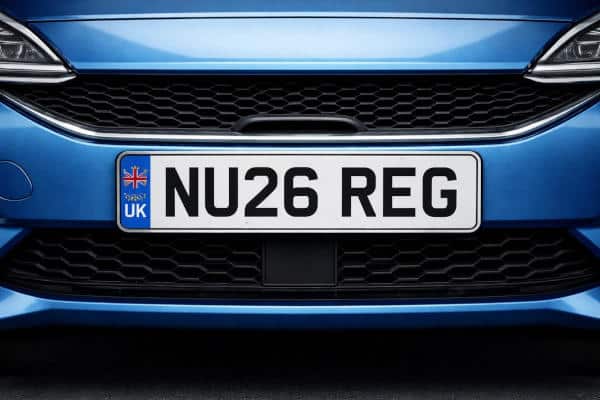
Modern UK registration plates follow a standard format consisting of two letters, two numbers and three additional letters. While most drivers recognise the age identifier in the middle of the plate, each section has a specific purpose.
Local Memory Tag
The first two letters identify the region where the vehicle was originally registered. Known as the local memory tag, these characters are assigned by the Driver and Vehicle Licensing Agency (DVLA) and help identify the registration office responsible for issuing the plate.
For example:
- LA – London
- MA – Manchester and Merseyside
- CA – Wales
- YA – Yorkshire
Age Identifier
The two numbers in the middle of the registration plate are known as the age identifier. These indicate when the vehicle was first registered.
Vehicles registered between 1st March and 31st August use the current year number, while vehicles registered between 1st September and the end of February use the year number plus 50.
For example:
- AB25 XYZ = March 2025 to August 2025
- AB75 XYZ = September 2025 to February 2026
Random Letters
The final three letters are random identifiers. These letters are allocated sequentially and do not provide any information about the vehicle’s age, specification or place of registration.
Their purpose is simply to create a unique registration number for each vehicle.
Older UK Registration Plate Years (Prefix System)
Before the current registration system was introduced in September 2001, UK vehicles used a prefix registration system. Under this format, the first letter of the registration plate identified the vehicle’s registration year.
For example, an A plate vehicle was first registered between August 1983 and July 1984, while an X plate vehicle was first registered between August 2000 and February 2001.
| Registration Year | Plate Letter |
|---|---|
| 2000 – 2001 | X |
| 1999 – 2000 | V |
| 1998 – 1999 | S |
| 1997 – 1998 | R |
| 1996 – 1997 | P |
| 1995 – 1996 | N |
| 1994 – 1995 | M |
| 1993 – 1994 | L |
| 1992 – 1993 | K |
| 1991 – 1992 | J |
| 1990 – 1991 | H |
| 1989 – 1990 | G |
| 1988 – 1989 | F |
| 1987 – 1988 | E |
| 1986 – 1987 | D |
| 1985 – 1986 | C |
| 1984 – 1985 | B |
| 1983 – 1984 | A |
EV Number Plates
Since December 2020, eligible zero-emission electric vehicles have been able to display a green flash on the left-hand side of their registration plates. The green flash is optional and helps identify fully electric vehicles, although hybrid vehicles are not eligible.
While the green flash can quickly identify some electric vehicles, it should not be relied upon when purchasing vehicle accessories, as not all EV owners choose to display it.
If you own an electric vehicle, it’s also worth considering whether EV-specific floor layouts, battery packaging and fixing systems affect your choice of car mats. Read our guide: Do EVs Need Different Car Mats?
Personalised Registration Plates
It is important to remember that some vehicles display personalised registration plates. These registrations are perfectly legal and often disguise the true age of a vehicle.
For this reason, registration plates should not be used as the sole method of identifying a vehicle when purchasing parts, accessories or tailored car mats.
Why Registration Years Can Be Misleading
If you are buying a vehicle, trying to identify a particular model or ordering tailored car mats, it is always advisable to verify the vehicle’s registration year and model details rather than relying solely on the number plate.
While registration years can help identify the age of a vehicle, they do not always identify the exact model generation. Manufacturers often introduce facelifts, interior changes and new fixing systems during a vehicle’s production life.
If in doubt, always check your vehicle’s model generation, body style, or VIN information, particularly during model changeover years where two different versions of the same vehicle may share identical registration years.